
Acupuncture and Chiropractic for Rotator Cuff Relief

Acupuncture and Chiropractic for Rotator Cuff: Benefits for Faster Relief You’ve been patient with your rotator cuff injury. You’ve rested it, iced it, maybe worked through a round of physical therapy or anti-inflammatories. And yet the ache lingers, reaching overhead still feels risky, and progress has stalled. If single-treatment approaches haven’t fully worked, the problem may not be your effort — it may be that your shoulder needs more than one kind of care working at the same time. That’s where acupuncture and chiropractic for rotator cuff injuries come in. Used together, these two therapies reach different layers of the same problem, and many patients notice meaningful, faster relief than either approach delivers on its own. Why One Treatment Alone Often Isn’t Enough A rotator cuff injury is rarely a single problem. There’s the mechanical side — restricted joint movement, a shoulder blade that isn’t tracking well, or a stiff neck that changes how your arm moves. There’s the soft-tissue side — tight, guarded muscles and irritated tendons. And there’s the pain-and-inflammation side that keeps the whole area sensitive and slow to heal. Treat only one of these layers, and the others quietly hold you back. Combining acupuncture and chiropractic for rotator cuff issues ensures that all layers of the injury are addressed at once. What Chiropractic Care Does for Your Shoulder Chiropractic care targets the mechanics of the shoulder. Your rotator cuff doesn’t work in isolation — it depends on a well-aligned spine, a mobile shoulder blade, and a neck that moves freely. When any of these are restricted, the rotator cuff tendons get pinched and irritated with everyday movement. Gentle adjustments and joint mobilization restore proper motion, take pressure off the tendons, and give the shoulder room to heal. Hands-on muscle release calms the tight, protective muscles that build up around an injured shoulder, so the joint can move the way it’s meant to. What Acupuncture Adds to Rotator Cuff Recovery Acupuncture works on a different layer: pain, circulation, and inflammation. Fine needles placed at specific points help calm the nervous system’s pain response and encourage fresh blood flow to the injured tissue. Better circulation means more oxygen and nutrients reaching tendons that are trying to repair themselves. Many patients also find that acupuncture releases deep muscle tension that manual therapy alone doesn’t fully reach.From a Traditional Chinese Medicine perspective, integrating acupuncture and chiropractic for rotator cuff pain supports the body’s natural healing signals — easing the guarding and sensitivity that keep a shoulder locked up. Why Combine Acupuncture and Chiropractic for Rotator Cuff Injuries? Here’s the key idea: chiropractic care fixes how the shoulder moves, while acupuncture calms how it feels and heals. Address both at once, and each therapy makes the other more effective. When acupuncture lowers pain and inflammation, your shoulder tolerates adjustments and rehab exercises far better. When chiropractic care restores proper joint mechanics, the tissue acupuncture is helping to heal is no longer re-irritated with every movement. The result is a recovery that keeps moving forward instead of stalling. Instead of chasing symptoms with one tool while the underlying cause goes untreated, you’re treating cause and symptom together. For many patients, that’s the difference between weeks of frustration and steady, visible progress. What Faster Recovery Actually Looks Like Combined care isn’t a magic overnight fix, and individual results vary. But a common pattern looks like this: pain and night discomfort tend to ease first, often within the early visits. Range of motion improves next, as the joint moves more freely and the muscles relax. Strength and confidence with overhead activity return last, as the tendons rebuild. Because both therapies are working together, patients using acupuncture and chiropractic for rotator cuff rehabilitation often reach these milestones sooner than with a single approach. Who Benefits from Acupuncture and Chiropractic for Rotator Cuff Injuries? Acupuncture and chiropractic care are both safe, drug-free, and non-surgical, which makes combined care a strong first-line option for many rotator cuff injuries. They also complement other care you may already be doing, including physical therapy and at-home exercises. The best way to know if it’s right for you is a proper assessment. A thorough exam identifies exactly which layers of your injury need attention — so your plan targets the real problem, not just the symptoms. Frequently Asked Questions Is it safe to combine acupuncture and chiropractic care? Yes. Both are gentle, non-invasive therapies designed to work well together. Your practitioner coordinates the two so they support one another rather than overlap. How many sessions will I need? It depends on how long you’ve had the injury and how severe it is. Many patients notice improvement within the first few visits, with a typical plan spanning several weeks. Your assessment provides a clear, personalized estimate. Does acupuncture hurt? Most people feel little to nothing when the fine needles are placed. Some notice a mild, dull heaviness at the point, which is completely normal and usually relaxing. Can I still do my physical therapy exercises? Absolutely. Combined care often makes rehab easier, because reduced pain and better joint mechanics let you exercise with less discomfort and better form. How soon will I feel results? Many patients feel some pain relief early on, though full recovery takes time. Because two therapies are working together, progress often comes faster than with one modality alone. Yes. Both are gentle, non-invasive therapies designed to work well together. Your practitioner coordinates the two so they support one another rather than overlap. It depends on how long you’ve had the injury and how severe it is. Many patients notice improvement within the first few visits, with a typical plan spanning several weeks. Your assessment provides a clear, personalized estimate. Most people feel little to nothing when the fine needles are placed. Some notice a mild, dull heaviness at the point, which is completely normal and usually relaxing. Absolutely. Combined care often makes rehab easier, because reduced pain and better joint mechanics let you exercise with less discomfort and
Cervical Dysfunction & Rotator Cuff: The Neck-Shoulder Link

The Neck-to-Shoulder Connection: How Cervical Dysfunction Causes Rotator Cuff Injuries Most people never consider their neck when their shoulder starts hurting. They assume the problem originates in the shoulder itself—perhaps from lifting something heavy, falling awkwardly, or overusing the joint in sports or work. But what if the real problem started much higher, in your cervical spine? The neck-to-shoulder connection is one of the most overlooked relationships in musculoskeletal health. Yet understanding this connection explains why some rotator cuff injuries resist treatment, why pain persists despite aggressive physical therapy, and why integrated approaches that address both the neck and shoulder succeed where shoulder-focused treatment fails. The Anatomical Foundation: Why Your Neck Directly Controls Your Shoulder Your shoulder blade is not an isolated structure. It’s controlled by a network of muscles originating from your neck and upper back. The upper trapezius, lower trapezius, levator scapulae, rhomboid, and serratus anterior—all these muscles attach to your shoulder blade, but they originate from your cervical and thoracic vertebrae. This anatomical arrangement means your neck doesn’t just support your head. It’s the command center for your shoulder blade’s position and function. When cervical vertebrae are properly aligned, they send clear neurological signals to these muscles through intact nerves. The muscles receive these signals, contract appropriately, and position your shoulder blade exactly where it needs to be. But when cervical vertebrae become misaligned—subluxated in chiropractic terminology—something insidious happens. The nerves exiting those vertebrae become irritated or compressed. They cannot transmit proper signals to the shoulder-controlling muscles. Those muscles either become overactive or underactive. The shoulder blade’s position shifts, subtly at first, then more dramatically over time. This is the beginning of rotator cuff injury, and it started in your neck. How Cervical Dysfunction Creates Shoulder Blade Dysfunction Imagine your cervical spine as the foundation of a building. If that foundation shifts even slightly, everything built above it becomes unstable. The shoulder blade, suspended by muscles originating from that unstable foundation, cannot position itself correctly. It sits too high, too far forward, or rotates improperly. When the shoulder blade is positioned incorrectly, the geometry of your entire shoulder joint changes. The space where rotator cuff tendons live becomes compressed. The tendons, which evolved to function within a specific spatial relationship to surrounding bones, suddenly get pinched between bone and soft tissue—what doctors call subacromial impingement. This impingement isn’t dramatic or acute. It’s a chronic, low-grade compression that occurs with every arm movement. Over days and weeks, the compressed tendons become inflamed. Over months, they begin to fray. Over years, they tear. What seemed like a rotator cuff injury appearing suddenly actually developed gradually, rooted in cervical dysfunction that preceded the shoulder pain by months or years. The Cervical-Shoulder Pain Cascade The cascade typically unfolds predictably. A person develops poor posture—either from occupational demands (desk work, looking down at phones) or from an old injury they thought had healed. This posture creates tension in neck muscles. The tension pulls cervical vertebrae slightly out of alignment. The misaligned vertebrae irritate nerves. The irritated nerves fail to properly control shoulder-blade muscles. The shoulder blade shifts position. At this point, many people don’t experience shoulder pain yet. They might notice neck stiffness or mild headaches, which they attribute to stress or tech use. They don’t connect these neck symptoms to their shoulder. Then someone asks them to lift something overhead. Or they reach for an object on a high shelf. Or they throw a ball. The poorly positioned shoulder blade cannot accommodate these movements smoothly. The rotator cuff tendons get compressed. Pain erupts in the shoulder, seemingly out of nowhere. The person goes to their doctor or physical therapist, and treatment focuses entirely on the shoulder. They receive rotator cuff exercises, ice, and anti-inflammatory medications. The pain might decrease initially. But without addressing the cervical dysfunction causing the shoulder blade to position incorrectly, treatment plateaus. The pain often returns. Why Standard Shoulder Treatment Often Misses the Mark Physical therapy protocols for rotator cuff injury typically emphasize strengthening and stretching exercises targeting the rotator cuff and shoulder blade muscles. This approach makes logical sense if you believe the problem is local to the shoulder. But if the problem originates in cervical dysfunction, local shoulder treatment is treating a symptom while leaving the cause untouched. It’s like treating a leaking roof by mopping the floor rather than fixing the hole in the roof itself. A patient can perform perfect rotator cuff exercises flawlessly, but if their cervical spine is misaligned and their shoulder blade is positioned incorrectly, those exercises are happening against a dysfunctional foundation. Progress stalls. Frustration builds. The Neurological Component of Cervical-Rotator Cuff Connection Beyond the mechanical relationship lies an equally important neurological one. Your cervical nerves don’t just control muscles; they carry sensory information and proprioceptive feedback—your brain’s awareness of where your body parts are in space. When cervical nerves are irritated, proprioceptive feedback from the shoulder becomes distorted. Your brain receives inaccurate information about shoulder position. Muscle activation patterns become inefficient. The shoulder becomes functionally unstable even though the rotator cuff itself is fine. This explains why some patients with rotator cuff injuries report feeling like their shoulder might “slip out” or feeling instability despite normal imaging. The rotator cuff isn’t structurally deficient; it’s just receiving garbled instructions from a nervous system compromised by cervical dysfunction. Testing for Cervical Involvement in Shoulder Pain A skilled practitioner can identify cervical involvement through specific tests. Cervical range-of-motion restrictions, especially rotation and extension, often accompany rotator cuff pain rooted in cervical dysfunction. Nerve tension tests that provoke shoulder symptoms when performing specific neck movements indicate cervical involvement. Muscle strength testing in shoulder muscles that should be controlled by specific nerve roots can reveal patterns consistent with cervical nerve irritation. Imaging tells an important story too. X-rays or MRI of the cervical spine might reveal degenerative changes, misalignments, or disc issues. While some of these findings occur naturally with age, they become
Rotator Cuff Injury: Muscle Release + Spinal Adjustments + Acupuncture – Why This Combination Heals

You’ve likely heard the phrase “rotator cuff injury” countless times—whether from your own diagnosis, a friend’s experience, or a sports commentator discussing an athlete’s career-threatening shoulder problem. But here’s what most people don’t realize: the most effective rotator cuff healing doesn’t come from treating just the rotator cuff itself. It comes from a three-phase protocol that addresses your entire shoulder system simultaneously. When muscle release, spinal adjustments, and acupuncture work together in the right sequence, they create a synergy that single treatments simply cannot achieve. This integrated approach isn’t experimental or alternative—it’s rooted in how your nervous system, muscles, and tendons were designed to heal. Why Single-Treatment Approaches Fall Short Consider what happens when someone receives only physical therapy for a rotator cuff injury. The therapist leads them through exercises designed to strengthen the rotator cuff and improve mobility. For the first few weeks, this feels effective. Pain decreases. Range of motion improves. But then progress plateaus. Many people find that despite consistent effort, they hit a ceiling where therapy alone cannot take them further. This happens because physical therapy addresses only one aspect of the problem: muscular strength and movement patterns. It doesn’t address the muscular tightness preventing the shoulder blade from positioning correctly. It doesn’t address cervical misalignments that interfere with nerve signaling to those muscles. And it doesn’t address the neurological and energetic components of healing that allow tissue to truly regenerate. The same limitation applies to acupuncture alone or chiropractic adjustments alone. Each modality is powerful, but each operates within its own domain. True rotator cuff recovery requires crossing those domains—which is why the integrated protocol works where single approaches plateau. Phase One: Muscle Release Prepares the Foundation Before any adjustment holds and before acupuncture reaches its full potential, the shoulder’s supporting muscles must release. Muscles around a rotator cuff injury enter what’s called a protective guarding pattern. Your body tightens these muscles to splint and protect the injured area—an intelligent short-term response. But when guarding persists, chronically tight muscles create a cascade of problems. They restrict blood flow, preventing oxygen and nutrients from reaching tissues. They lock joints into abnormal positions. They perpetuate the very dysfunction that caused the injury originally. Muscle release—through myofascial release, trigger point therapy, and deep tissue mobilization—breaks this protective cycle. These techniques work at multiple levels simultaneously. They identify hyperiritable spots within muscle tissue and release the tension locked there. They work with the fascia, the connective tissue wrapping muscles, to restore normal tissue mobility. They improve local circulation, triggering the body’s natural healing response. The critical point: muscle release alone produces temporary relief. Without the next two phases, muscles will retighten because the underlying structural problems remain unaddressed. But as Phase One of an integrated protocol, muscle release primes the shoulder for transformation. Phase Two: Spinal Adjustments Restore Neurological Command Once tissues are prepared, cervical and thoracic spinal adjustments deliver what muscle release cannot: restoration of neurological control. Your shoulder blade is controlled by muscles originating from your neck and upper back. When vertebrae in these regions become misaligned, they interfere with the nerves communicating with those muscles. The muscles literally cannot receive proper signals from your nervous system. Even the strongest, most flexible muscles cannot function optimally without correct neurological input. A chiropractic adjustment restores vertebral alignment and movement. This immediately restores nerve function. Suddenly, muscles controlling your shoulder blade receive clear signals from your brain. They can contract and relax in proper sequence. The shoulder blade can return to its correct resting position. The geometry of your entire shoulder joint normalizes. This is why adjustments are so powerful: they don’t just reduce pain or improve mobility in the moment. They restore the neurological foundation that allows your musculoskeletal system to function as designed. Muscles can finally maintain the corrections that muscle release created. The shoulder blade can stay in proper position rather than immediately reverting to dysfunction. Phase Three: Acupuncture Accelerates Healing and Brings Stability After muscle release has cleared restrictions and spinal adjustments have restored neurological control, acupuncture completes the healing process in ways neither treatment alone can achieve. At a physiological level, acupuncture reduces inflammation around injured tendons, improves local circulation, and stimulates the release of endorphins and other neurochemicals involved in pain modulation. But acupuncture does something more sophisticated: it regulates your nervous system at a deeper level. Most people exist in a chronic state of sympathetic activation—the fight-or-flight response. This state increases inflammation, diverts resources away from healing, and perpetuates pain signaling. Acupuncture shifts your autonomic nervous system toward parasympathetic activation—the rest-and-digest state where genuine healing happens. From a Western scientific perspective, acupuncture stimulates fibroblasts, the cells that produce collagen—the structural component of tendons. This means acupuncture isn’t just managing symptoms; it’s actually rebuilding tissue. From a traditional perspective, acupuncture restores the flow of chi through meridians that regulate shoulder function and stability. Regardless of framework, the practical result is identical: acupuncture brings the stability and deep healing that concludes the recovery process. Why Sequence Matters More Than Individual Techniques The order of these three phases isn’t arbitrary—it’s essential. Skip muscle release and try adjustments first, and muscles immediately pull vertebrae back out of alignment because they’re too tight to maintain correction. Try acupuncture without releasing muscles and correcting alignment, and the effects remain superficial and temporary. The underlying problems that generated the injury persist. But follow the sequence—muscle release, then adjustments, then acupuncture—and each phase makes the next one exponentially more effective. Muscle release allows adjustments to hold. Adjustments allow acupuncture to reach deeper tissues and produce lasting effects. Acupuncture seals and stabilizes everything, enabling genuine tissue regeneration. What Recovery Timeline Looks Like Most patients experience noticeable relief after 2-3 sessions. This initial improvement comes primarily from muscle release reducing protective guarding and spinal adjustments restoring neurological function. Real transformation happens over 6-8 weeks of consistent treatment. By week 8, people typically report significant functional
Why Your Rotator Cuff Injury Isn’t Really a Rotator Cuff Problem: The Scapular Dysfunction Connection

You’ve been told you have a rotator cuff injury. You’ve done rotator cuff exercises. You’ve iced it, rested it, maybe even considered surgery. But what if the real problem isn’t your rotator cuff at all? This realization—that most rotator cuff injuries are actually scapular dysfunction problems—fundamentally changes how you approach treatment and recovery. And it explains why some people recover completely while others struggle for months or years despite doing “everything right.” The truth is, your rotator cuff injury is likely a symptom, not the problem. The actual problem is sitting higher up, in a structure most people have never even heard of: your scapula, or shoulder blade. Understanding the Anatomy: Where the Problem Really Starts The scapula is a triangular bone that sits flat against your ribcage. It’s not rigidly attached—instead, it’s held in place by muscles. Dozens of muscles, actually. And here’s the critical part: many of these muscles originate from your neck and upper back. The upper trapezius, lower trapezius, serratus anterior, rhomboid, and levator scapulae all attach to your scapula. These muscles also connect to your cervical spine (neck vertebrae) and thoracic spine (upper back vertebrae). When these muscles aren’t functioning properly—when they’re tight, weak, or imbalanced—your scapula doesn’t sit where it should. This misalignment of the shoulder blade is called scapular dyskinesis. And it creates a cascade of problems that eventually damages the rotator cuff. How Scapular Dysfunction Leads to Rotator Cuff Injury When your shoulder blade is positioned incorrectly, the entire geometry of your shoulder joint changes. Think of your shoulder as a complex mechanical system where every component depends on precise positioning. In a healthy shoulder, the scapula rotates smoothly as you lift your arm, maintaining space around the rotator cuff tendons. But when the scapula is dysfunctional—sitting too far forward, too high, or too rotated—it changes the arc of movement. The rotator cuff tendons, which live in a confined space, suddenly get compressed. This compression is called subacromial impingement. And this is where the injury actually occurs. The tendons get pinched, they become inflamed, they start to fray, and eventually they tear. Here’s the crucial insight: the rotator cuff tendons weren’t weak. They weren’t overused in the way you might think. They were being crushed by poor positioning of the bone that sits above them. This is why so many people can do rotator cuff strengthening exercises and still not improve. They’re strengthening a structure that doesn’t have a strength problem. They’re treating the symptom while the root cause—scapular dysfunction—continues to create compression. The Cervical Connection: Where Your Neck Injury Became a Shoulder Problem Many people don’t realize that their rotator cuff problem started in their neck. Because the muscles that control scapular position originate from your cervical spine, dysfunction in your neck directly affects shoulder blade positioning. Poor posture—hours hunched over a desk, looking down at your phone—creates tension and weakness in the muscles connecting your neck to your shoulder blade. The upper trapezius becomes tight while the lower trapezius becomes weak. The levator scapulae shortens while the serratus anterior becomes inhibited. This muscular imbalance pulls your shoulder blade into an abnormal position. And from that moment forward, every time you lift your arm, you’re creating impingement on your rotator cuff tendons. Some people develop this over months. Some over years. But the pattern is consistent: cervical dysfunction creates scapular dysfunction, which creates rotator cuff injury. Why Standard Rotator Cuff Treatment Often Fails If your shoulder blade is sitting two centimeters too far forward, rotator cuff exercises won’t fix that mechanical problem. You could perform perfect form 1,000 times, and the underlying issue remains unchanged. This explains why people often report that physical therapy helped initially but then the pain returned. Or why they improved 50% but hit a plateau that no amount of exercise could overcome. The scapular dysfunction was never addressed. Traditional treatment focuses on the symptom—the rotator cuff—without correcting the mechanical dysfunction creating the problem. It’s like patching a roof leak without identifying that the gutter is clogged. The water always finds another way. The Solution: Restoring Scapular Function True rotator cuff injury recovery requires a three-phase approach that addresses scapular dysfunction directly. Phase One: Muscle Release. Tight muscles—especially the upper trapezius, levator scapulae, and pectoralis—must be released. When these muscles are chronically tight, they physically pull the scapula into dysfunction. Soft tissue therapy, including trigger point release and myofascial work, begins restoring normal muscle length and flexibility. Phase Two: Spinal Adjustments. Cervical and thoracic vertebral misalignments interfere with nerve function to the muscles controlling the scapula. When those nerves can’t communicate properly, the muscles can’t function properly. Chiropractic adjustments restore normal vertebral positioning and neurological function, allowing the muscles to respond correctly to movement. Phase Three: Acupuncture and Stabilization. Strategic acupuncture points release muscle tension, reduce inflammation, and bring stability to the scapular region. Combined with specific scapular stabilization exercises—performed only after the foundation of muscle release and adjustments is in place—the shoulder blade can return to proper positioning. Only when all three components work together does the scapula stabilize. Only then does the rotator cuff finally get relief from compression. And only then can true healing begin. What This Means for Your Recovery If you have a rotator cuff injury, the first question isn’t “What’s wrong with my rotator cuff?” The first question is “Why is my scapula positioned incorrectly?” This shift in perspective changes everything about your treatment. It explains why some people recover completely while others don’t. It reveals why you might need to address your neck to heal your shoulder. It clarifies why a comprehensive, integrated approach—combining muscle release, spinal adjustments, and acupuncture—outperforms single-modality treatments. Most importantly, it offers hope. Your rotator cuff wasn’t damaged by a structural defect or irreversible degeneration. It was compressed by a mechanical dysfunction that, once corrected, allows healing to proceed naturally. Your rotator cuff injury isn’t really a rotator cuff
Acupuncture and Chiropractic: The Powerful Combination That Transforms Pain Relief

If you’ve been managing chronic pain, muscle tension, or spinal dysfunction, you’ve likely considered visiting either an acupuncturist or a chiropractor. But what if you didn’t have to choose between them? What if the most powerful pain relief approach combines both therapies? The integration of acupuncture and chiropractic represents a paradigm shift in how we approach musculoskeletal and pain-related conditions. Rather than viewing these two healing modalities as separate disciplines, forward-thinking practitioners in Toronto and beyond are discovering that they complement each other perfectly, creating results that exceed what either treatment alone can achieve. How Acupuncture and Chiropractic Address Pain from Different Angles To understand why acupuncture and chiropractic work so well together, it’s helpful to recognize that they address pain through different but complementary mechanisms. Acupuncture works through the body’s energy systems and neurological pathways. Traditional Chinese medicine views pain as a disruption in the flow of qi (pronounced “chee”), the vital life force that circulates through the body’s meridians. Acupuncturists place fine needles at specific points to restore this flow and reduce pain signals. Modern neuroscience has validated many of these effects, showing that acupuncture stimulates the release of endorphins, reduces inflammation, and modulates how your nervous system processes pain. Chiropractic care, by contrast, focuses on structural alignment. When your vertebrae become misaligned—a condition chiropractors call subluxations—they can interfere with nerve function, restrict movement, and create mechanical stress on muscles and ligaments. A skilled chiropractor identifies these misalignments and uses precise adjustments to restore proper alignment and movement. This mechanical correction reduces nerve irritation, improves joint function, and allows your body to heal more effectively. In other words, acupuncture regulates function while chiropractic adjusts structure. When you receive both treatments as part of an integrated care plan, you’re addressing pain from multiple angles simultaneously. The Synergistic Benefits of Acupuncture and Chiropractic Together When an acupuncturist and chiropractor work together—or when a single practitioner offers both services—patients typically experience faster, more substantial pain relief than they would from either treatment alone. This synergy works in several ways. First, acupuncture often reduces muscle tension and inflammation before a chiropractic adjustment, making the adjustment more effective and comfortable. Subsequently, after the adjustment, your body is primed to benefit more deeply from acupuncture. The realigned vertebrae create better space for nerves and blood vessels, and the mobilized tissues are more receptive to acupuncture’s effects. Second, the combination addresses both functional and structural problems. You might have reduced qi flow, exacerbating pain signals (functional problem), and a misaligned vertebra causing nerve interference (structural problem). Addressing only one aspect leaves you vulnerable to continued discomfort. But when you treat both the function and the structure, you resolve the underlying causes more completely. Third, patients often report that integrated treatment reduces their overall recovery time. Instead of spending three months addressing pain signaling and then another three months addressing structural issues, many patients see significant improvement within four to six weeks of combined acupuncture and chiropractic therapy. Conditions That Respond Exceptionally Well to Acupuncture and Chiropractic Certain conditions show particularly impressive results when acupuncture and chiropractic are combined. Lower back pain, one of the most common reasons people seek treatment for musculoskeletal issues, often responds exceptionally well. The combination addresses both the functional pain response that acupuncture excels at managing and the mechanical dysfunction that chiropractic corrects. Neck pain and cervical spine issues benefit greatly from integrated treatment. The upper cervical spine is delicate and complex, and combining targeted acupuncture with careful adjustments can resolve conditions that resist single-modality treatment. Headaches and migraines, whether tension-based or stemming from cervical dysfunction, often show dramatic improvement. Acupuncture is particularly effective for migraines, while chiropractic adjustments address structural cervical causes. Shoulder and rotator cuff problems, repetitive strain injuries, and sports injuries all respond well to this integrated approach. Athletes and active individuals often report faster return to activity when they combine both therapies. Pregnancy-related pain is another area where many patients appreciate acupuncture and chiropractic integration. Acupuncturists address nausea, fatigue, and labor preparation while pregnancy chiropractors safely adjust the changing spine—creating comprehensive prenatal care. What to Expect in an Integrated Acupuncture and Chiropractic Practice If you’re considering this combined approach, understanding what to expect helps you get the most from treatment. During your initial consultation, a practitioner experienced in both disciplines will take a comprehensive history and perform detailed assessments. They’ll evaluate your spinal alignment, range of motion, pain patterns, and overall health picture. If they’re trained in both acupuncture and chiropractic, they’ll also assess your tongue and pulse—traditional diagnostic tools that provide valuable information about your body’s state. Your personalized treatment plan typically integrates or alternates both therapies. You might receive acupuncture followed by a chiropractic adjustment in the same session, or treatments might be scheduled on different days depending on your condition and preference. Most practitioners recommend more frequent initial visits—perhaps twice weekly—then taper to maintenance visits as you improve. The experience is generally comfortable. Modern acupuncture needles are extremely fine, and most people don’t feel significant discomfort. Chiropractic adjustments, particularly from practitioners trained in both modalities, are often gentler than traditional adjustments because the acupuncture component reduces muscle guarding and tension. Why Toronto Professionals Choose Integrated Acupuncture and Chiropractic Care Toronto’s busy professionals—whether working in the Financial District, King West, or other downtown neighborhoods—face unique challenges to spinal health. Long commutes, desk work, high stress, and demanding schedules create the perfect storm for pain and dysfunction. Many Toronto residents appreciate the efficiency of integrated acupuncture and chiropractic care. Rather than managing two separate practitioners and navigating between offices, integrated treatment consolidates care in one location with one practitioner who understands your complete health picture. This efficiency is invaluable for people juggling professional responsibilities and personal wellness. Additionally, many private health insurance plans in Toronto cover both acupuncture and chiropractic, making integrated care an accessible investment in long-term health. Supporting Your Recovery Between Acupuncture and Chiropractic Sessions While acupuncture and chiropractic provide powerful interventions, your at-home care significantly impacts results. Most practitioners will recommend specific
Paraspinal Muscles: What They Are, Where They Are, and How to Keep Them Healthy
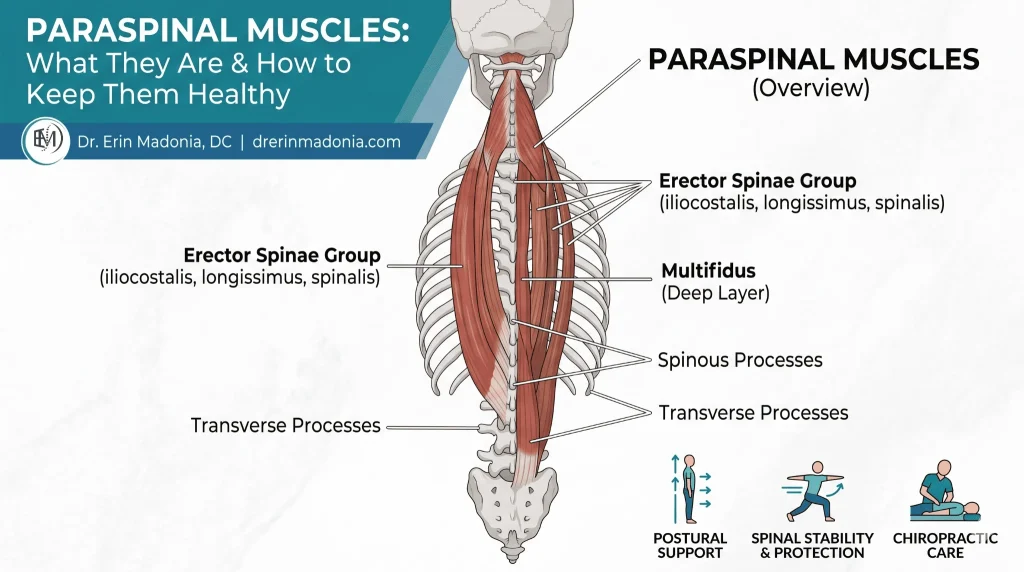
If you have ever experienced that deep, aching tension running along both sides of your spine after a long day at the desk, a tough workout, or a stressful week, there is a good chance your paraspinal muscles are asking for attention. These muscles are essential for almost every movement your body makes, yet most people have never heard of them until something goes wrong. In this post, you will learn exactly what paraspinal muscles are, where they are located, what they do, why they become painful, and — most importantly — how chiropractic care and targeted exercises can help you keep them functioning at their best. What Are Paraspinal Muscles? The term paraspinal muscles (also called paraspinal musculature or paravertebral muscles) refers to the group of muscles that run parallel to and on either side of the spinal column. The prefix para comes from Greek, meaning “beside” or “along” — so paraspinal literally means “along the spine.” These muscles are not a single muscle but rather a complex layered system of muscles that span the entire length of the spine, from the base of the skull all the way down to the sacrum. Together, they form the primary muscular support structure for your vertebral column. Where Are the Paraspinal Muscles Located? The paraspinal muscles are situated in the posterior (back) compartment of the trunk, flanking the spine on both sides. They occupy the grooves between the spinous processes (the bony bumps you feel down the center of your back) and the transverse processes (the bony projections that extend outward from each vertebra). The paraspinal muscle group is commonly divided into three main layers: Superficial layer – Includes the erector spinae group (iliocostalis, longissimus, and spinalis), which are the largest and most palpable paraspinal muscles. Intermediate layer – Contains the semispinalis and other multifidus muscles, which provide finer control of spinal movement. Deep layer – Houses smaller muscles like the rotatores and interspinales, which play a critical role in proprioception and precise vertebral positioning. What Do the Paraspinal Muscles Do? The paraspinal muscles serve several critical functions that make them indispensable to your daily life: 1. Spinal Extension and Rotation The primary movement controlled by the paraspinal muscles is extension — straightening your back when you stand up from a seated position, arch backward, or lift an object off the ground. They also contribute to lateral bending (side-to-side movement) and rotation of the trunk. 2. Postural Support Even when you are simply standing or sitting still, your paraspinal muscles are working continuously to keep your spine upright against gravity. Poor posture over time can lead to chronic overload of these muscles, resulting in fatigue and pain. 3. Spinal Stability and Protection Working in coordination with the core muscles (including the transverse abdominis and multifidus), the paraspinal muscles create a dynamic brace around the spine. This is what allows you to carry groceries, play sports, or pick up your child without injuring your vertebrae or discs. 4. Proprioception The deep paraspinal muscles are loaded with proprioceptors — sensory receptors that inform your brain about the position and movement of your spine. This feedback loop is essential for balance, coordination, and injury prevention. Why Do Paraspinal Muscles Become Painful? Paraspinal muscle pain is one of the most common complaints seen in chiropractic practice. The causes range from acute injuries to chronic dysfunction: Prolonged sitting or poor workstation ergonomics Muscle strain from heavy lifting or sudden awkward movements Vertebral subluxations (misalignments) that alter loading patterns on the muscles Spinal disc degeneration or herniation, which can cause protective muscle guarding Stress and tension, which lead to habitual muscle bracing Weak core musculature, which shifts excess load onto the paraspinal muscles When paraspinal muscles are overworked or injured, they can develop trigger points — tight, irritable knots that refer pain to other areas of the back, hips, or even the legs. How Chiropractic Care Helps the Paraspinal Muscles Chiropractic care is one of the most effective and evidence-informed approaches for addressing paraspinal muscle dysfunction. Here is how it works: Spinal Adjustments When vertebrae are misaligned, the paraspinal muscles on one side often become hypertonic (too tight) while those on the opposite side become inhibited (too weak). Chiropractic adjustments restore proper vertebral alignment, which immediately reduces the abnormal muscle tension and allows the nervous system to re-regulate muscle tone. Soft Tissue Therapy Techniques such as Active Release Therapy (ART), myofascial release, and instrument-assisted soft tissue mobilization (IASTM) can break up adhesions and trigger points within the paraspinal muscles, restoring normal tissue mobility and reducing pain. Rehabilitative Exercises Dr. Erin Madonia integrates specific exercises to strengthen and properly activate the paraspinal muscles as part of a comprehensive care plan. Strong, well-coordinated paraspinal muscles are the best long-term defense against recurring back pain. 3 Simple Exercises to Support Your Paraspinal Muscles at Home These exercises are gentle enough for most people and can be done daily to support spinal health: Bird-Dog – From a hands-and-knees position, extend one arm and the opposite leg simultaneously. Hold for 5 seconds. Repeat 10 times per side. Superman Hold – Lie face down, lift arms and legs off the floor simultaneously, hold 3–5 seconds. Repeat 10 times. Cat-Cow Stretch – On hands and knees, alternate between arching and rounding your spine. Perform 10 slow, controlled repetitions. Always consult a qualified healthcare provider before beginning any new exercise program, especially if you are currently experiencing back pain. Frequently Asked Questions About Paraspinal Muscles What is the difference between paraspinal muscles and core muscles? While the core includes muscles on all sides of the trunk (front, sides, and back), paraspinal muscles specifically refer to the muscles located on the posterior (back) side of the spine. They work together with the core for optimal spinal stability. Can a chiropractor help with paraspinal muscle pain? Yes. Chiropractors
Chiropractic Healthy Tips for Summer

As the days stretch longer and the sun lingers a little brighter, I’m reminded why summer is such a powerful season for our bodies and minds. Warmer weather invites us outdoors, encourages natural movement, and offers a fresh reset for healthy habits. At Family Chiropractic, we see how small, consistent choices in this season can make a big difference in how you feel—more energized, more mobile, and more connected to the activities you love. Here are a few simple, chiropractic-informed tips to make the most of this beautiful summer weather. SUMMER CHIROPRACTIC TIPS 1. Move with the season Trade “workouts” for play. Walking the neighborhood after dinner, paddleboarding at the lake, gardening, or playing tag with the kids all count as functional movement that supports joint health and balance. Build variety into your week. Aim for a mix of light cardio (brisk walks, cycling), mobility work (gentle morning stretches), and strength (bodyweight squats, resistance bands). Your spine thrives on movement diversity. Think “micro-movements.” If you’re at a barbecue or ball game, add a few posture resets: shoulder rolls, chin tucks, and calf stretches every 45–60 minutes. 2. Hydrate like it matters—because it does Dehydration is sneaky in summer. Bring a water bottle and sip regularly, especially in the afternoon heat. Add electrolytes if you’re sweating more than usual or spending extended time outdoors. Your discs need water. Healthy hydration helps keep spinal discs supple and can reduce feelings of stiffness. 3. Sun smart, spine smart Enjoy the sunshine for natural vitamin D—morning and late afternoon are gentler on the skin. Protect your posture with your sun gear: choose a lightweight backpack over a single-strap bag, and keep loads close to your body to reduce strain on your neck and low back. Sunglasses aren’t just about glare—squinting can encourage forward head posture. Relaxed eyes help a relaxed cervical spine. 4. Make recovery part of the plan Balance busy days with short evening wind-downs: legs-up-the-wall for 3–5 minutes, gentle hip flexor stretches, or a warm shower followed by light mobility can calm the nervous system and ease muscle tension. Sleep cooler. A small bedside fan or breathable sheets can improve sleep quality, which is when tissues repair and the spine resets. Schedule chiropractic tune-ups. Seasonal shifts in activity (hello, yardwork and weekend sports) can reveal alignment issues before they become pain. 5. Yardwork and weekend warrior wisdom Warm up first: 3 minutes of brisk walking, 10 bodyweight squats, and 10 arm circles. It’s simple and makes a real difference. Lift with your legs, not your back. Keep items close to your body, hinge at the hips, and avoid twisting while carrying. Break it up. Set a timer for 20–30 minutes, then change tasks or stretch. Your back prefers intervals over marathons. 6. Posture-friendly picnics and patios If you’re on low chairs or blankets, switch positions often. Try sitting cross-legged for a bit, then side-sitting, then kneeling. Use a small rolled towel at your low back for natural lumbar support when you’re in camp chairs. On long drives to summer destinations, stop every 60–90 minutes for two minutes of walking and gentle back extensions. A quick morning stretch flow Two deep belly breaths with hands on ribs. Cat-cow x 6 to mobilize the spine. World’s greatest stretch x 3/side for hips and thoracic rotation. Standing back extensions x 5 with hands on hips. Finish with 30 seconds of shoulder blade squeezes. A season to reset Summer is an invitation—to move more, breathe deeper, and reconnect with what helps you feel at home in your body. If a new activity has left you a bit achy, if old patterns are creeping back in, or if you simply want to keep your spine moving well all season, I’m here to help you create a simple, personalized plan. Here’s to long sunsets, easy movement, and feeling fantastic all summer long. In health, Dr. Erin Madonia Family Chiropractic Dr. Erin Madonia has been providing chiropractic care to the King West neighbourhood since 2014, specializing in safe and effective relief of spinal complaints while optimizing central nervous system function. To learn more or schedule an appointment, contact us at dr.erin.madonia@gmail.com or visit our office at 130 Spadina Ave, Suite 808, Toronto. For more information, you can book a free consultation or schedule an appointment with us by clicking the buttons down below 👇 Book a Free Consultation Book an Appointment
Understanding Different Types of Headaches — And How Chiropractic Care and Acupuncture May Help

Headaches are one of the most common health complaints worldwide. For some people, they’re an occasional inconvenience. For others, they interfere with work, sleep, exercise, and everyday life. While medications can provide temporary relief, many people also look for complementary approaches that address underlying tension, posture, stress, and musculoskeletal dysfunction. Two commonly explored non-pharmaceutical options are chiropractic care and acupuncture. Both approaches aim to reduce pain, improve function, and support the body’s natural healing processes — though they do so in different ways. Here’s a closer look at the most common types of headaches and how these therapies may play a role in treatment Types of Headaches 1. Tension Headaches Tension headaches are the most common type of headache. They’re often described as a dull, aching pressure or tight band around the forehead, temples, or back of the head. Common Causes Stress and anxiety Poor posture Muscle tension in the neck and shoulders Long hours at a computer Jaw clenching or teeth grinding Sleep disturbances Symptoms Mild to moderate pain Tightness or pressure Tender scalp or neck muscles Pain on both sides of the head How Chiropractic Care May Help Chiropractic treatment for tension headaches often focuses on improving spinal mobility and reducing muscle tension, particularly in the cervical spine (neck). Poor posture and restricted neck joints can contribute to ongoing strain and irritation. A chiropractor may use: Spinal adjustments Soft tissue therapy Postural correction strategies Ergonomic recommendations Stretching and strengthening exercises Some patients report fewer headache episodes and reduced intensity after improving neck function and posture. How Acupuncture May Help Acupuncture is commonly used to reduce muscle tension and calm the nervous system. Thin needles are inserted into specific points in the body to encourage circulation and relaxation. For tension headaches, acupuncture may help: Reduce stress-related muscle tightness Promote relaxation Improve sleep quality Decrease headache frequency Many people find acupuncture especially beneficial when stress is a major trigger. 2. Migraines Migraines are more than “bad headaches.” They are a neurological condition that can significantly affect quality of life. Common Triggers Hormonal changes Stress Certain foods or alcohol Sleep disruption Bright lights or strong smells Weather changes Symptoms Moderate to severe throbbing pain Usually one-sided Nausea or vomiting Sensitivity to light and sound Visual disturbances (aura) How Chiropractic Care May Help While chiropractic care is not considered a cure for migraines, some individuals experience improvement when contributing musculoskeletal issues are addressed. Treatment may focus on: Neck mobility Muscle tension reduction Postural balance Trigger identification Patients who experience migraines alongside neck stiffness or tension may notice reduced mechanical stress after treatment. How Acupuncture May Help Acupuncture is one of the more widely researched complementary therapies for migraines. Some studies suggest it may help decrease the frequency and intensity of migraine attacks for certain individuals. Potential benefits include: Nervous system regulation Stress reduction Improved circulation Relaxation of tight muscles Many migraine sufferers use acupuncture as part of a broader management plan that may also include nutrition, sleep regulation, hydration, and medical care. 3. Cervicogenic Headaches Cervicogenic headaches originate from dysfunction in the neck structures — including joints, muscles, and nerves. Common Causes Whiplash injuries Poor posture Neck arthritis Muscle imbalance Repetitive strain Symptoms Pain that starts in the neck Reduced neck range of motion Headache on one side Pain that worsens with neck movement Shoulder or arm discomfort How Chiropractic Care May Help This is one of the headache types most commonly associated with chiropractic treatment because the source of the pain often involves spinal and muscular dysfunction. A chiropractor may use: Cervical spinal adjustments Joint mobilization Soft tissue therapy Corrective exercises The goal is to improve neck mechanics and reduce irritation contributing to the headache. How Acupuncture May Help Acupuncture may complement chiropractic care by targeting muscular tightness and inflammation around the neck and shoulders. It may help: Relax overactive muscles Reduce pain sensitivity Improve circulation Support recovery after injury Some patients choose to combine both therapies for a more comprehensive approach. 4. Cluster Headaches Cluster headaches are less common but extremely painful. They occur in cyclical patterns or “clusters.” Symptoms Severe burning or piercing pain Usually around one eye Eye tearing or redness Nasal congestion Restlessness during attacks Important Note Cluster headaches require medical evaluation. They are often managed with prescription medications and neurological care. Role of Chiropractic and Acupuncture Evidence for chiropractic treatment in cluster headaches is limited, but some individuals seek supportive care for associated neck tension or stress. Acupuncture may help some patients manage: Stress Muscle tension Overall pain coping strategies However, these therapies should complement — not replace — medical management for cluster headaches. 5. Sinus Headaches Sinus headaches are associated with sinus inflammation and congestion. Symptoms Pressure around the eyes, cheeks, and forehead Facial tenderness Congestion Pain that worsens when bending forward How Chiropractic Care May Help Some chiropractors focus on improving drainage and reducing muscular tension around the neck and upper spine. Supportive therapies may help improve comfort, especially if neck tension develops alongside sinus pressure. How Acupuncture May Help Acupuncture is often used to support sinus-related symptoms by encouraging circulation and reducing inflammation. Patients may report: Reduced facial pressure Improved nasal drainage Better breathing comfort The Importance of a Proper Diagnosis Not every headache is benign. Frequent or severe headaches should always be evaluated by a healthcare professional, especially if they involve: Sudden severe pain Neurological symptoms Vision loss Weakness or numbness Fever Confusion Headaches after trauma A proper diagnosis helps determine whether chiropractic care, acupuncture, medication, physical therapy, or another treatment approach is most appropriate. Can Chiropractic and Acupuncture Work Together? In many cases, yes. Chiropractic care and acupuncture are often used together because they target different aspects of headache pain. Chiropractic Care Often Focuses On: Joint movement Posture Biomechanics Muscle imbalance Acupuncture Often Focuses On: Nervous system regulation Relaxation Pain modulation Energy flow and circulation Together, they may provide a more comprehensive strategy for managing chronic headache patterns. Lifestyle Habits That Can Help Reduce Headaches In addition to professional
When Nerve Flossing Isn’t Working: The Signs You Need More Than Home Exercises

What Is the Vagus Nerve and Why Does It Matter? You searched “nerve flossing exercises.” You watched the YouTube videos. You’ve been doing the movements every morning for two weeks. And your arm still tingles. Your leg still burns at night. The sciatic pain that woke you up at 3 a.m. on Tuesday? Still there. Here’s what nobody in those videos tells you: nerve flossing is a tool, not a treatment. And if it isn’t working — or if it’s making things worse — your body is sending you a message worth listening to. What Nerve Flossing Actually Does (And What It Doesn’t) Nerve flossing, also called nerve gliding, is a gentle mobilization technique that helps restore movement to nerves that have become restricted, compressed, or irritated. When your nervous system is functioning well, nerves slide smoothly through surrounding tissue as you move. When they don’t, you feel it — as tingling, numbness, shooting pain, or that “electric” sensation down your leg or arm. The technique works by creating a gentle tension-and-release action along the nerve pathway, improving blood flow and reducing hypersensitivity in the nerve tissue. For mild cases of nerve irritation, it can be genuinely helpful as a home exercise. But nerve flossing treats a symptom of movement restriction — it doesn’t address why the nerve became restricted in the first place. 5 Signs Your Nerve Pain Needs Professional Care If any of the following sound familiar, it’s time to stop relying on at-home exercises and book an appointment with a chiropractor who can identify and treat the root cause. 1. You’ve been doing nerve flossing for more than two weeks without improvement. Two weeks is a reasonable trial period for mild nerve irritation. If your symptoms haven’t shifted, there’s likely a structural reason the nerve keeps getting restricted — a disc issue, a spinal misalignment, or soft tissue adhesion that exercises alone won’t resolve. 2. Your symptoms are getting worse, not better. This is important: nerve flossing done incorrectly, or applied to the wrong condition, can aggravate nerve symptoms. If tingling has spread, numbness has increased, or you’re now experiencing muscle weakness, stop the exercises and seek an assessment right away. 3. You feel pain during the movements, not just tension. A mild pulling sensation is normal. Actual pain — sharp, burning, or electrical — during nerve flossing is a red flag. Healthy nerve mobilization should never be painful. Pain during these movements suggests the nerve is more compressed or inflamed than at-home exercises can safely address. 4. You have bilateral symptoms (both sides of your body). Numbness or tingling in both hands, or pain radiating down both legs, can signal something more systemic going on with your spine or nervous system. This warrants professional evaluation without delay. 5. Your symptoms appeared after a specific incident — a fall, a car accident, or lifting something heavy. Nerve symptoms that follow trauma can indicate a disc herniation or acute spinal issue. These need to be assessed properly before any mobilization exercises are introduced. In cases like these, nerve flossing can sometimes do more harm than good without clinical guidance. What a Chiropractor Actually Does for Nerve Pain When a patient comes to us at Dr. Erin Madonia Family Chiropractic in King West, Toronto with persistent nerve symptoms, the first step is never to just prescribe more exercises. It’s to understand why the nerve is irritated. A proper clinical assessment looks at the full picture: your posture, spinal alignment, disc health, soft tissue restrictions, and how your nervous system is currently functioning. This lets us pinpoint whether the issue is cervical (neck) or lumbar (lower back) in origin, which specific nerve root is involved, and what’s causing the compression or irritation. From there, treatment typically includes a combination of chiropractic adjustments to restore proper joint alignment and take pressure off the affected nerve, soft tissue therapy to release adhesions in the surrounding muscles and fascia, tailored nerve gliding exercises that are specific to your condition and safe for your current level of irritation, and postural coaching to address the habits that contributed to the problem in the first place. Nerve flossing exercises absolutely have a role in recovery — but as part of a guided plan, not a substitute for one. Common Conditions Behind Persistent Nerve Pain The nerve symptoms that send people to YouTube looking for nerve flossing videos are usually caused by one of the following: Sciatica — compression or irritation of the sciatic nerve, most often caused by a lumbar disc herniation or piriformis syndrome. Symptoms include pain, tingling, or numbness radiating from the lower back down the leg, sometimes all the way to the foot. Cervical radiculopathy — a pinched nerve in the neck that causes symptoms down the arm and into the hand. Common in people who work at desks, look down at phones frequently, or carry tension in the shoulders and upper back. Carpal tunnel syndrome — median nerve compression at the wrist that causes numbness and tingling in the thumb, index, and middle fingers. Nerve flossing can help as a complement to treatment, but rarely resolves it on its own. Thoracic outlet syndrome — compression of nerves and blood vessels between the collarbone and first rib, often presenting as pain, weakness, or numbness in the shoulder, arm, and hand. Each of these conditions responds differently to treatment. Getting the diagnosis right is the only way to get the treatment right. The Cost of Waiting We see patients regularly who spent months doing online exercises before seeking care — and who wish they hadn’t waited. Nerve irritation that goes unaddressed tends to progress. What starts as occasional tingling can become chronic numbness. What begins as manageable discomfort can become radiating pain that disrupts sleep and limits daily function. The nervous system is remarkably resilient, but it does respond to time. Earlier intervention consistently leads to faster, more complete recovery. If your nerve symptoms have been present for more than a few weeks,
Beyond Pain Relief: How Chiropractic Care Activates Your Vagus Nerve for Better Mental Health
If you’ve ever visited a chiropractor, you likely went seeking relief from back pain, neck stiffness, or headaches. But what if your adjustment could do more than ease physical discomfort? What if it could also calm your racing mind, reduce anxiety, and help you sleep better at night? This isn’t wishful thinking—it’s neuroscience. The key lies in understanding a remarkable nerve that connects your brain to nearly every major organ in your body: the vagus nerve. Recent research reveals that chiropractic adjustments, particularly those targeting the upper cervical spine, can directly influence vagal tone and, by extension, your mental health. For Toronto professionals juggling demanding careers, long commutes, and the constant pressure to perform, this mind-body connection offers a compelling reason to reconsider what chiropractic care can do for overall wellness. What Is the Vagus Nerve and Why Does It Matter? The vagus nerve is the longest cranial nerve in your body, running from your brainstem down through your neck and into your chest and abdomen. Think of it as your body’s major highway for communication between your brain and your vital organs—including your heart, lungs, and digestive system. But the vagus nerve does far more than relay messages. It’s the primary component of your parasympathetic nervous system, often called the “rest and digest” system. When your vagus nerve is functioning optimally, it acts like a brake pedal on your stress response, helping you shift from fight-or-flight mode into a state of calm and recovery. Scientists measure vagal function through something called vagal tone. Higher vagal tone correlates with better emotional regulation, reduced inflammation, improved heart rate variability, and greater resilience to stress. Conversely, low vagal tone is associated with anxiety, depression, chronic inflammation, and digestive issues. The Neck-Nerve Connection: Where Chiropractic Comes In Here’s where things get interesting for anyone seeking natural approaches to mental health. The vagus nerve exits your skull and travels down through the upper cervical spine—specifically near the atlas and axis vertebrae at the base of your skull. This anatomical relationship means that misalignments, tension, or dysfunction in this area can directly impact vagal nerve function. Chiropractors are uniquely trained to identify and correct these upper cervical misalignments through precise, gentle adjustments. When the spine is properly aligned and moving freely, it can reduce mechanical stress on the vagus nerve and surrounding tissues, potentially improving vagal tone and function. Research published in peer-reviewed journals has begun documenting these effects. Studies show that chiropractic adjustments can influence heart rate variability—a key marker of vagal tone—and reduce markers of stress in the body. While more research is needed, the preliminary findings suggest that spinal health and nervous system regulation are intimately connected. How Vagal Activation Affects Your Mental Health Understanding the vagus nerve helps explain why some chiropractic patients report feeling calmer, sleeping better, or experiencing reduced anxiety after their adjustments—even when they originally came in for neck pain or headaches. When the vagus nerve is activated and functioning well, several beneficial processes occur. Your heart rate variability improves, which is associated with better emotional regulation and stress resilience. Your body’s inflammatory response becomes better regulated, reducing the chronic low-grade inflammation linked to depression and anxiety disorders. Digestive function improves, which matters because gut health and mental health are closely connected through the gut-brain axis. Your body shifts more easily into parasympathetic mode, allowing for deeper relaxation and better sleep quality. For busy professionals experiencing burnout, these effects can be transformative. The constant activation of your sympathetic nervous system—the fight-or-flight response—takes a serious toll. Traffic jams, back-to-back meetings, email notifications, and deadline pressure all trigger this stress response. Over time, your nervous system can get stuck in high-alert mode, making it difficult to truly relax even when you have downtime. Chiropractic care that supports vagal function offers a way to help your nervous system find its off switch again. It’s not about eliminating stress—that’s impossible in modern life—but about improving your body’s ability to recover and return to balance. The Upper Cervical Advantage While all chiropractic adjustments aim to restore proper nervous system function, upper cervical adjustments deserve special attention when it comes to mental health benefits. The atlas vertebra, which sits at the very top of your spine, has a particularly close relationship with the vagus nerve and the brainstem. Misalignments in this area can create what chiropractors call subluxations—functional disturbances that interfere with nerve communication. Because the upper cervical spine houses so many crucial neurological structures, even small misalignments here can have outsized effects on how your nervous system functions. Upper cervical chiropractors use specialized techniques that are gentle yet precise. Rather than the traditional twisting or popping that many people associate with chiropractic care, these adjustments often involve subtle pressure or specific instrument-assisted corrections. The goal is to restore optimal alignment and movement without creating additional stress on the tissues. Beyond Adjustments: Supporting Your Vagus Nerve While chiropractic care can be a powerful tool for improving vagal tone, it works best as part of a comprehensive approach to nervous system health. There are several complementary practices that can further support vagal function. Deep diaphragmatic breathing activates the vagus nerve directly. Taking slow, deep breaths that expand your belly rather than your chest stimulates vagal pathways and triggers the relaxation response. Cold exposure, such as splashing cold water on your face or taking brief cold showers, can also stimulate the vagus nerve and improve its tone over time. Humming, singing, or chanting creates vibrations in your throat that mechanically stimulate the vagus nerve. This is one reason why people often report feeling calmer after singing or meditation practices that involve vocalization. Social connection and laughter also activate vagal pathways, highlighting the importance of community and joy for nervous system health. Movement practices like yoga combine breathwork, gentle spinal movement, and stress reduction—all of which support vagal function. When paired with regular chiropractic care, these practices create a synergistic effect that can significantly improve your stress resilience. What to Expect: The Patient Experience If you’re