
If you have ever experienced that deep, aching tension running along both sides of your spine after a long day at the desk, a tough workout, or a stressful week, there is a good chance your paraspinal muscles are asking for attention. These muscles are essential for almost every movement your body makes, yet most people have never heard of them until something goes wrong.
In this post, you will learn exactly what paraspinal muscles are, where they are located, what they do, why they become painful, and — most importantly — how chiropractic care and targeted exercises can help you keep them functioning at their best.
What Are Paraspinal Muscles?
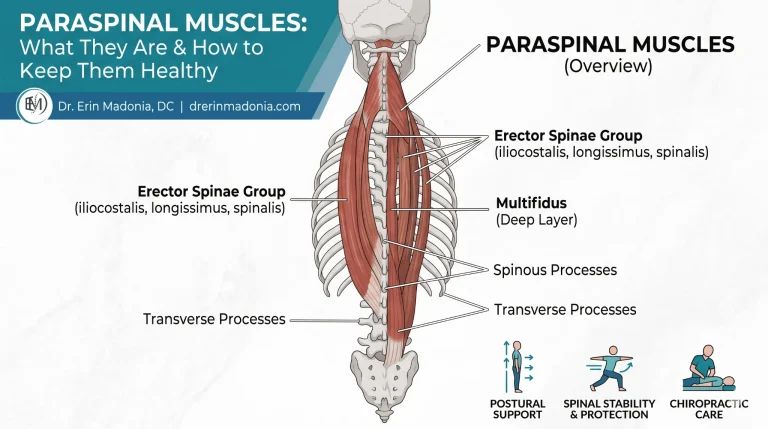
The term paraspinal muscles (also called paraspinal musculature or paravertebral muscles) refers to the group of muscles that run parallel to and on either side of the spinal column. The prefix para comes from Greek, meaning “beside” or “along” — so paraspinal literally means “along the spine.”
These muscles are not a single muscle but rather a complex layered system of muscles that span the entire length of the spine, from the base of the skull all the way down to the sacrum. Together, they form the primary muscular support structure for your vertebral column.
Where Are the Paraspinal Muscles Located?
The paraspinal muscles are situated in the posterior (back) compartment of the trunk, flanking the spine on both sides. They occupy the grooves between the spinous processes (the bony bumps you feel down the center of your back) and the transverse processes (the bony projections that extend outward from each vertebra).
The paraspinal muscle group is commonly divided into three main layers:
- Superficial layer – Includes the erector spinae group (iliocostalis, longissimus, and spinalis), which are the largest and most palpable paraspinal muscles.
- Intermediate layer – Contains the semispinalis and other multifidus muscles, which provide finer control of spinal movement.
- Deep layer – Houses smaller muscles like the rotatores and interspinales, which play a critical role in proprioception and precise vertebral positioning.
What Do the Paraspinal Muscles Do?
The paraspinal muscles serve several critical functions that make them indispensable to your daily life:
1. Spinal Extension and Rotation
The primary movement controlled by the paraspinal muscles is extension — straightening your back when you stand up from a seated position, arch backward, or lift an object off the ground. They also contribute to lateral bending (side-to-side movement) and rotation of the trunk.
2. Postural Support
Even when you are simply standing or sitting still, your paraspinal muscles are working continuously to keep your spine upright against gravity. Poor posture over time can lead to chronic overload of these muscles, resulting in fatigue and pain.
3. Spinal Stability and Protection
Working in coordination with the core muscles (including the transverse abdominis and multifidus), the paraspinal muscles create a dynamic brace around the spine. This is what allows you to carry groceries, play sports, or pick up your child without injuring your vertebrae or discs.
4. Proprioception
The deep paraspinal muscles are loaded with proprioceptors — sensory receptors that inform your brain about the position and movement of your spine. This feedback loop is essential for balance, coordination, and injury prevention.
Why Do Paraspinal Muscles Become Painful?
Paraspinal muscle pain is one of the most common complaints seen in chiropractic practice. The causes range from acute injuries to chronic dysfunction:
- Prolonged sitting or poor workstation ergonomics
- Muscle strain from heavy lifting or sudden awkward movements
- Vertebral subluxations (misalignments) that alter loading patterns on the muscles
- Spinal disc degeneration or herniation, which can cause protective muscle guarding
- Stress and tension, which lead to habitual muscle bracing
- Weak core musculature, which shifts excess load onto the paraspinal muscles
When paraspinal muscles are overworked or injured, they can develop trigger points — tight, irritable knots that refer pain to other areas of the back, hips, or even the legs.
How Chiropractic Care Helps the Paraspinal Muscles
Chiropractic care is one of the most effective and evidence-informed approaches for addressing paraspinal muscle dysfunction. Here is how it works:
Spinal Adjustments
When vertebrae are misaligned, the paraspinal muscles on one side often become hypertonic (too tight) while those on the opposite side become inhibited (too weak). Chiropractic adjustments restore proper vertebral alignment, which immediately reduces the abnormal muscle tension and allows the nervous system to re-regulate muscle tone.
Soft Tissue Therapy
Techniques such as Active Release Therapy (ART), myofascial release, and instrument-assisted soft tissue mobilization (IASTM) can break up adhesions and trigger points within the paraspinal muscles, restoring normal tissue mobility and reducing pain.
Rehabilitative Exercises
Dr. Erin Madonia integrates specific exercises to strengthen and properly activate the paraspinal muscles as part of a comprehensive care plan. Strong, well-coordinated paraspinal muscles are the best long-term defense against recurring back pain.
3 Simple Exercises to Support Your Paraspinal Muscles at Home
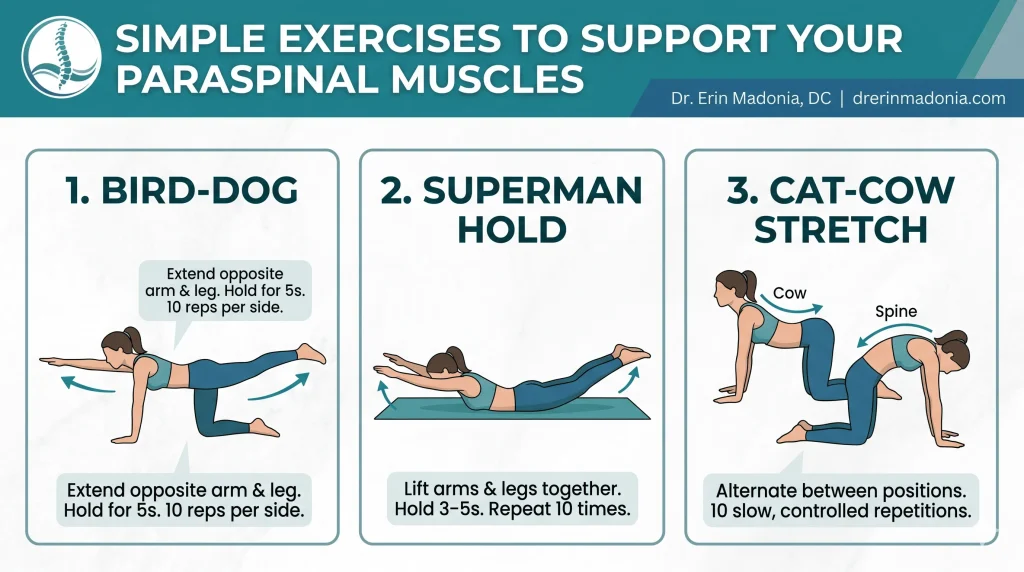
These exercises are gentle enough for most people and can be done daily to support spinal health:
- Bird-Dog – From a hands-and-knees position, extend one arm and the opposite leg simultaneously. Hold for 5 seconds. Repeat 10 times per side.
- Superman Hold – Lie face down, lift arms and legs off the floor simultaneously, hold 3–5 seconds. Repeat 10 times.
- Cat-Cow Stretch – On hands and knees, alternate between arching and rounding your spine. Perform 10 slow, controlled repetitions.
Always consult a qualified healthcare provider before beginning any new exercise program, especially if you are currently experiencing back pain.
Frequently Asked Questions About Paraspinal Muscles
What is the difference between paraspinal muscles and core muscles?
While the core includes muscles on all sides of the trunk (front, sides, and back), paraspinal muscles specifically refer to the muscles located on the posterior (back) side of the spine. They work together with the core for optimal spinal stability.
Can a chiropractor help with paraspinal muscle pain?
Yes. Chiropractors are trained to assess and treat paraspinal muscle dysfunction through a combination of spinal adjustments, soft tissue therapy, and exercise rehabilitation. Many patients experience significant relief after just a few sessions.
Final Thoughts
Your paraspinal muscles are the unsung heroes of your spinal health. They work every second of every day to keep you upright, mobile, and protected. When they are healthy and strong, you move freely and without pain. When they become tight, weak, or overloaded, your entire spine feels it.
If you are experiencing paraspinal muscle pain or chronic back tension in the Toronto area, Dr. Erin Madonia offers comprehensive chiropractic assessments and personalized treatment plans designed to address the root cause — not just the symptoms.
➡ Book your assessment today at drerinmadonia.com and take the first step toward a healthier spine.
Dr. Erin Madonia has been providing chiropractic care to the King West neighbourhood since 2014, specializing in safe and effective relief of spinal complaints while optimizing central nervous system function. To learn more or schedule an appointment, contact us at dr.erin.madonia@gmail.com or visit our office at 130 Spadina Ave, Suite 808, Toronto.