
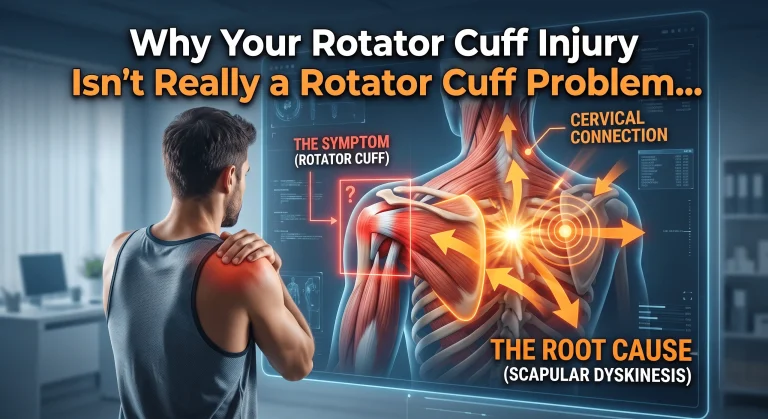
You’ve been told you have a rotator cuff injury. You’ve done rotator cuff exercises. You’ve iced it, rested it, maybe even considered surgery. But what if the real problem isn’t your rotator cuff at all?
This realization—that most rotator cuff injuries are actually scapular dysfunction problems—fundamentally changes how you approach treatment and recovery. And it explains why some people recover completely while others struggle for months or years despite doing “everything right.”
The truth is, your rotator cuff injury is likely a symptom, not the problem. The actual problem is sitting higher up, in a structure most people have never even heard of: your scapula, or shoulder blade.
Understanding the Anatomy: Where the Problem Really Starts
The scapula is a triangular bone that sits flat against your ribcage. It’s not rigidly attached—instead, it’s held in place by muscles. Dozens of muscles, actually. And here’s the critical part: many of these muscles originate from your neck and upper back.
The upper trapezius, lower trapezius, serratus anterior, rhomboid, and levator scapulae all attach to your scapula. These muscles also connect to your cervical spine (neck vertebrae) and thoracic spine (upper back vertebrae). When these muscles aren’t functioning properly—when they’re tight, weak, or imbalanced—your scapula doesn’t sit where it should.
This misalignment of the shoulder blade is called scapular dyskinesis. And it creates a cascade of problems that eventually damages the rotator cuff.
How Scapular Dysfunction Leads to Rotator Cuff Injury
When your shoulder blade is positioned incorrectly, the entire geometry of your shoulder joint changes. Think of your shoulder as a complex mechanical system where every component depends on precise positioning.
In a healthy shoulder, the scapula rotates smoothly as you lift your arm, maintaining space around the rotator cuff tendons. But when the scapula is dysfunctional—sitting too far forward, too high, or too rotated—it changes the arc of movement. The rotator cuff tendons, which live in a confined space, suddenly get compressed.
This compression is called subacromial impingement. And this is where the injury actually occurs. The tendons get pinched, they become inflamed, they start to fray, and eventually they tear.
Here’s the crucial insight: the rotator cuff tendons weren’t weak. They weren’t overused in the way you might think. They were being crushed by poor positioning of the bone that sits above them.
This is why so many people can do rotator cuff strengthening exercises and still not improve. They’re strengthening a structure that doesn’t have a strength problem. They’re treating the symptom while the root cause—scapular dysfunction—continues to create compression.
The Cervical Connection: Where Your Neck Injury Became a Shoulder Problem
Many people don’t realize that their rotator cuff problem started in their neck. Because the muscles that control scapular position originate from your cervical spine, dysfunction in your neck directly affects shoulder blade positioning.
Poor posture—hours hunched over a desk, looking down at your phone—creates tension and weakness in the muscles connecting your neck to your shoulder blade. The upper trapezius becomes tight while the lower trapezius becomes weak. The levator scapulae shortens while the serratus anterior becomes inhibited.
This muscular imbalance pulls your shoulder blade into an abnormal position. And from that moment forward, every time you lift your arm, you’re creating impingement on your rotator cuff tendons.
Some people develop this over months. Some over years. But the pattern is consistent: cervical dysfunction creates scapular dysfunction, which creates rotator cuff injury.
Why Standard Rotator Cuff Treatment Often Fails
If your shoulder blade is sitting two centimeters too far forward, rotator cuff exercises won’t fix that mechanical problem. You could perform perfect form 1,000 times, and the underlying issue remains unchanged.
This explains why people often report that physical therapy helped initially but then the pain returned. Or why they improved 50% but hit a plateau that no amount of exercise could overcome. The scapular dysfunction was never addressed.
Traditional treatment focuses on the symptom—the rotator cuff—without correcting the mechanical dysfunction creating the problem. It’s like patching a roof leak without identifying that the gutter is clogged. The water always finds another way.
The Solution: Restoring Scapular Function
True rotator cuff injury recovery requires a three-phase approach that addresses scapular dysfunction directly.
Phase One: Muscle Release. Tight muscles—especially the upper trapezius, levator scapulae, and pectoralis—must be released. When these muscles are chronically tight, they physically pull the scapula into dysfunction. Soft tissue therapy, including trigger point release and myofascial work, begins restoring normal muscle length and flexibility.
Phase Two: Spinal Adjustments. Cervical and thoracic vertebral misalignments interfere with nerve function to the muscles controlling the scapula. When those nerves can’t communicate properly, the muscles can’t function properly. Chiropractic adjustments restore normal vertebral positioning and neurological function, allowing the muscles to respond correctly to movement.
Phase Three: Acupuncture and Stabilization. Strategic acupuncture points release muscle tension, reduce inflammation, and bring stability to the scapular region. Combined with specific scapular stabilization exercises—performed only after the foundation of muscle release and adjustments is in place—the shoulder blade can return to proper positioning.
Only when all three components work together does the scapula stabilize. Only then does the rotator cuff finally get relief from compression. And only then can true healing begin.
What This Means for Your Recovery
If you have a rotator cuff injury, the first question isn’t “What’s wrong with my rotator cuff?” The first question is “Why is my scapula positioned incorrectly?”
This shift in perspective changes everything about your treatment. It explains why some people recover completely while others don’t. It reveals why you might need to address your neck to heal your shoulder. It clarifies why a comprehensive, integrated approach—combining muscle release, spinal adjustments, and acupuncture—outperforms single-modality treatments.
Most importantly, it offers hope. Your rotator cuff wasn’t damaged by a structural defect or irreversible degeneration. It was compressed by a mechanical dysfunction that, once corrected, allows healing to proceed naturally.
Your rotator cuff injury isn’t really a rotator cuff injury at all. It’s a scapular dysfunction presenting as shoulder pain. Once you understand that distinction, recovery becomes possible.
Dr. Erin Madonia has been providing chiropractic care to the King West neighbourhood since 2014, specializing in safe and effective relief of spinal complaints while optimizing central nervous system function. To learn more or schedule an appointment, contact us at dr.erin.madonia@gmail.com or visit our office at 130 Spadina Ave, Suite 808, Toronto.