
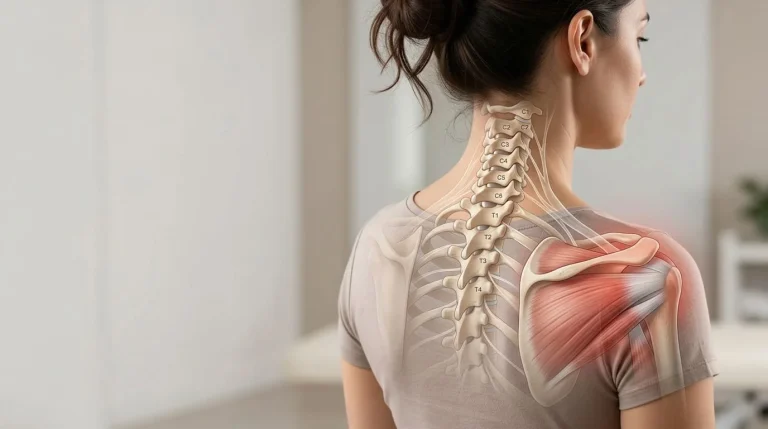
The Neck-to-Shoulder Connection: How Cervical Dysfunction Causes Rotator Cuff Injuries
Most people never consider their neck when their shoulder starts hurting. They assume the problem originates in the shoulder itself—perhaps from lifting something heavy, falling awkwardly, or overusing the joint in sports or work. But what if the real problem started much higher, in your cervical spine?
The neck-to-shoulder connection is one of the most overlooked relationships in musculoskeletal health. Yet understanding this connection explains why some rotator cuff injuries resist treatment, why pain persists despite aggressive physical therapy, and why integrated approaches that address both the neck and shoulder succeed where shoulder-focused treatment fails.
The Anatomical Foundation: Why Your Neck Directly Controls Your Shoulder
Your shoulder blade is not an isolated structure. It’s controlled by a network of muscles originating from your neck and upper back. The upper trapezius, lower trapezius, levator scapulae, rhomboid, and serratus anterior—all these muscles attach to your shoulder blade, but they originate from your cervical and thoracic vertebrae.
This anatomical arrangement means your neck doesn’t just support your head. It’s the command center for your shoulder blade’s position and function. When cervical vertebrae are properly aligned, they send clear neurological signals to these muscles through intact nerves. The muscles receive these signals, contract appropriately, and position your shoulder blade exactly where it needs to be.
But when cervical vertebrae become misaligned—subluxated in chiropractic terminology—something insidious happens. The nerves exiting those vertebrae become irritated or compressed. They cannot transmit proper signals to the shoulder-controlling muscles. Those muscles either become overactive or underactive. The shoulder blade’s position shifts, subtly at first, then more dramatically over time.
This is the beginning of rotator cuff injury, and it started in your neck.
How Cervical Dysfunction Creates Shoulder Blade Dysfunction
Imagine your cervical spine as the foundation of a building. If that foundation shifts even slightly, everything built above it becomes unstable. The shoulder blade, suspended by muscles originating from that unstable foundation, cannot position itself correctly. It sits too high, too far forward, or rotates improperly.
When the shoulder blade is positioned incorrectly, the geometry of your entire shoulder joint changes. The space where rotator cuff tendons live becomes compressed. The tendons, which evolved to function within a specific spatial relationship to surrounding bones, suddenly get pinched between bone and soft tissue—what doctors call subacromial impingement.
This impingement isn’t dramatic or acute. It’s a chronic, low-grade compression that occurs with every arm movement. Over days and weeks, the compressed tendons become inflamed. Over months, they begin to fray. Over years, they tear. What seemed like a rotator cuff injury appearing suddenly actually developed gradually, rooted in cervical dysfunction that preceded the shoulder pain by months or years.
The Cervical-Shoulder Pain Cascade
The cascade typically unfolds predictably. A person develops poor posture—either from occupational demands (desk work, looking down at phones) or from an old injury they thought had healed. This posture creates tension in neck muscles. The tension pulls cervical vertebrae slightly out of alignment. The misaligned vertebrae irritate nerves. The irritated nerves fail to properly control shoulder-blade muscles. The shoulder blade shifts position.
At this point, many people don’t experience shoulder pain yet. They might notice neck stiffness or mild headaches, which they attribute to stress or tech use. They don’t connect these neck symptoms to their shoulder.
Then someone asks them to lift something overhead. Or they reach for an object on a high shelf. Or they throw a ball. The poorly positioned shoulder blade cannot accommodate these movements smoothly. The rotator cuff tendons get compressed. Pain erupts in the shoulder, seemingly out of nowhere.
The person goes to their doctor or physical therapist, and treatment focuses entirely on the shoulder. They receive rotator cuff exercises, ice, and anti-inflammatory medications. The pain might decrease initially. But without addressing the cervical dysfunction causing the shoulder blade to position incorrectly, treatment plateaus. The pain often returns.
Why Standard Shoulder Treatment Often Misses the Mark
Physical therapy protocols for rotator cuff injury typically emphasize strengthening and stretching exercises targeting the rotator cuff and shoulder blade muscles. This approach makes logical sense if you believe the problem is local to the shoulder.
But if the problem originates in cervical dysfunction, local shoulder treatment is treating a symptom while leaving the cause untouched. It’s like treating a leaking roof by mopping the floor rather than fixing the hole in the roof itself.
A patient can perform perfect rotator cuff exercises flawlessly, but if their cervical spine is misaligned and their shoulder blade is positioned incorrectly, those exercises are happening against a dysfunctional foundation. Progress stalls. Frustration builds.
The Neurological Component of Cervical-Rotator Cuff Connection
Beyond the mechanical relationship lies an equally important neurological one. Your cervical nerves don’t just control muscles; they carry sensory information and proprioceptive feedback—your brain’s awareness of where your body parts are in space.
When cervical nerves are irritated, proprioceptive feedback from the shoulder becomes distorted. Your brain receives inaccurate information about shoulder position. Muscle activation patterns become inefficient. The shoulder becomes functionally unstable even though the rotator cuff itself is fine.
This explains why some patients with rotator cuff injuries report feeling like their shoulder might “slip out” or feeling instability despite normal imaging. The rotator cuff isn’t structurally deficient; it’s just receiving garbled instructions from a nervous system compromised by cervical dysfunction.
Testing for Cervical Involvement in Shoulder Pain
A skilled practitioner can identify cervical involvement through specific tests. Cervical range-of-motion restrictions, especially rotation and extension, often accompany rotator cuff pain rooted in cervical dysfunction. Nerve tension tests that provoke shoulder symptoms when performing specific neck movements indicate cervical involvement. Muscle strength testing in shoulder muscles that should be controlled by specific nerve roots can reveal patterns consistent with cervical nerve irritation.
Imaging tells an important story too. X-rays or MRI of the cervical spine might reveal degenerative changes, misalignments, or disc issues. While some of these findings occur naturally with age, they become clinically significant when they correlate with shoulder pain and dysfunction.
Integrating Cervical Treatment into Shoulder Recovery
The practical implication is straightforward: true rotator cuff recovery often requires addressing cervical dysfunction simultaneously with shoulder treatment. Chiropractic adjustments restore cervical alignment and nervous system function. Physical therapy works better when the cervical spine is properly aligned and sending correct signals. Acupuncture points in the neck regulate the neural pathways that control shoulder function.
This integrated approach—addressing both the cause in the cervical spine and the effect in the shoulder—produces outcomes single-focused treatment cannot achieve. Patients recover faster. Recovery lasts longer. Recurrence becomes less likely.
Recognizing When Your Neck Is the Culprit
If you have rotator cuff symptoms and also experience neck pain, stiffness, or headaches, cervical involvement is likely. If you developed shoulder pain after a neck injury, cervical involvement is probable. If you have poor posture, spend hours at a desk, or look down at your phone constantly, cervical dysfunction probably contributed to your shoulder problem.
The neck-to-shoulder connection is often the missing piece in shoulder recovery. Recognizing this connection transforms your treatment approach from local shoulder focus to integrated whole-system healing.
Dr. Erin Madonia has been providing chiropractic care to the King West neighbourhood since 2014, specializing in safe and effective relief of spinal complaints while optimizing central nervous system function. To learn more or schedule an appointment, contact us at dr.erin.madonia@gmail.com or visit our office at 130 Spadina Ave, Suite 808, Toronto.